

Country becomes a continental pioneer as it extends its e-IDSR platform to cover domestic animals and wildlife, training nearly 600 veterinary professionals and unifying surveillance data across all three One Health domains
KIGALI — On 3 November 2025, Rwanda used the global celebration of World One Health Day to make a landmark announcement: the official launch of the electronic Integrated Disease Surveillance and Response (e-IDSR) system for the animal health and wildlife sectors. The event, held at the College of Medicine and Health Sciences of the University of Rwanda under the theme “One Health: One Future — Leveraging Technology to Advance the One Health Agenda,” brought together senior government officials, international partners, academics, and hundreds of health professionals to witness what organisers described as a transformative milestone in the country’s public health architecture.
The e-IDSR system is not new to Rwanda. It was first adopted in 2002 for the human health sector to strengthen preparedness for epidemics and pandemics. By 2013, Rwanda became the first low-income country to implement the system nationwide using mobile technology, reaching all 521 health facilities across the country. However, until now, the animal and wildlife sectors had relied largely on paper-based reports and informal communication channels, a fragmentation that became starkly apparent during the COVID-19 pandemic and successive zoonotic disease outbreaks, including Rift Valley Fever and the 2024 Marburg Virus Disease outbreak.
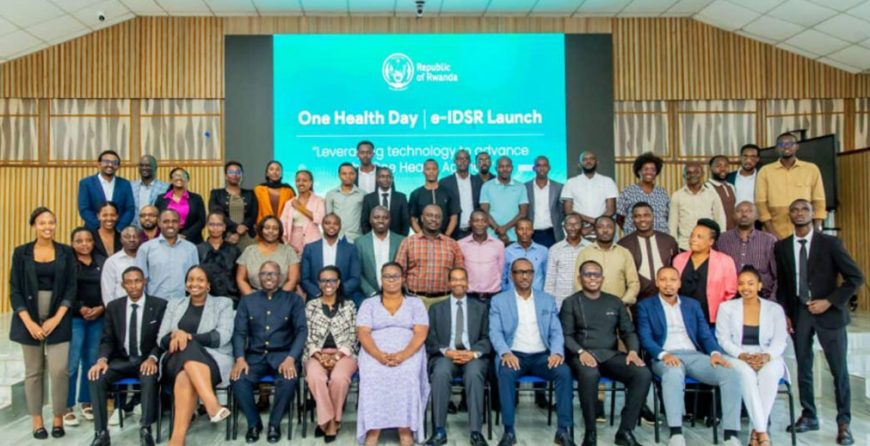
Group photo of participants during the One Health Day launch of the Integrated Disease Surveillance and Response (IDSR) system, marking a milestone in strengthening collaborative surveillance across human, animal, and environmental health sectors.
A SYSTEM BORN OF HARD LESSONS
The motivation for extending the e-IDSR to animal health grew out of painful operational realities. During outbreaks such as Rift Valley Fever, slow paper-based reporting from the veterinary sector delayed critical measures needed to protect human populations. The COVID-19 pandemic further revealed that while the human health e-IDSR had been strengthened to a high level, the continued reliance on manual reporting for animal and wildlife surveillance created critical gaps in data integration, triangulation, and timely cross-sectoral decision-making.
To address this fragmentation, the Rwanda Biomedical Centre (RBC), the Rwanda Agriculture and Animal Resources Development Board (RAB), the Rwanda Development Board (RDB), and partners — with the Clinton Health Access Initiative (CHAI) providing key technical and financial support — jointly developed the integrated digital surveillance platform that captures and analyses data across human, animal, and environmental health ecosystems.
“The launch of this technology is a major step in Rwanda’s effort to promote the One Health approach — integrating human, animal, and environmental health to prevent disease and improve overall well-being. This gives us the ability to respond promptly, use resources efficiently, and gain a clearer picture of how diseases spread.”
— Prof. Claude M. Muvunyi, Director General, Rwanda Biomedical Centre
FROM DEVELOPMENT TO DEPLOYMENT: THE ROLLOUT
The development process began in 2022, when stakeholders identified the animal diseases that needed monitoring and started defining indicators. By 2023, the system was ready for training. The first cohort of 60 veterinarians from districts and ministries were trained and subsequently cascaded the training to sector-level veterinarians nationwide.
According to Dr. Leandre Ishema, Acting Director of One Health at RBC, approximately 573 animal health professionals now use the system, including public veterinarians trained at national, district, and sector levels; approximately 100 private veterinarians operating under the Veterinary Sanitary Mandate; and around 30 wildlife veterinarians and park rangers from RDB. To bridge the digital divide, WHO provided over 300 tablets and FAO supplied an additional 275 to RAB, ensuring that even veterinarians in remote areas can report in real time from the field.
| E-IDSR AT A GLANCE |
| ● First adopted in Rwanda in 2002 for human health; nationwide since 2013 across all 521 health facilities |
| ● Extended to animal and wildlife health sectors, officially launched 3 November 2025 |
| ● Approximately 573 animal health professionals trained and using the system |
| ● Monitors six priority zoonotic diseases: rabies, Rift Valley Fever, trypanosomiasis, viral haemorrhagic fevers, brucellosis, and avian influenza |
| ● Reporting via web, mobile app, or SMS, including through the community-level “Impuruza” platform |
| ● Over 575 tablets distributed to field veterinarians by WHO, FAO, and USAID |
| ● Supported by CHAI and AIIB through the Pandemic Fund (US$24.9 million grant to Rwanda) |
| ● Dashboards for real-time reporting, planning, and decision-making already operational |
WHAT THE SYSTEM TRACKS
The government has identified six priority zoonotic diseases for surveillance: rabies, Rift Valley Fever, trypanosomiasis, viral haemorrhagic fevers, brucellosis, and avian influenza. However, the system also tracks other diseases that could threaten people, animals, or the economy — even those not directly transmissible to humans — providing a more complete picture of health risks across populations.
The platform captures a comprehensive suite of indicators, including morbidity and mortality rates, fatality and recovery rates, disease trends, laboratory turnaround times, vaccination coverage, and wildlife-specific metrics such as poaching incidents, snare removals, road kills, confiscation cases, and animal relocations. Data can be disaggregated by administrative location, time period, species, and other categorised variables, and the system generates visual dashboards for use in reporting and planning at all levels.
Reporting operates through multiple channels: the web, a mobile app, and SMS alerts. At the community level, the “Impuruza” platform enables community health workers and animal health workers to quickly notify authorities about incidents such as dog bites, suspected infections, or unusual animal deaths. Data flows from the village level up through the cell, sector, district, provincial, and national levels, with provincial Public Health Emergency Operations Centres tracking information and the national team overseeing all reported events.
WELCOME CEREMONY AND KEYNOTE ADDRESSES
The afternoon event opened with welcome remarks from the Division Manager of Public Health Surveillance, Emergencies Preparedness and Response (PHS&EPR) at RBC, who received the distinguished guests, including the Vice Chancellor of the University of Rwanda. Opening remarks were then delivered by Dr. Solange Uwituze, Minister of State for Agriculture and Animal Resources (MINAGRI) and former Acting Director General of the Rwanda Agriculture and Animal Resources Development Board (RAB). In his keynote address, Prof. Claude M. Muvunyi, Director General of the Rwanda Biomedical Centre, framed the launch within the broader arc of Rwanda’s One Health journey, tracing the country’s evolution from initial concept creation in 2011 through seven distinct phases of institutional collaboration, policy development, joint assessments, collaborative surveillance, joint coordination and response, enhanced surveillance, and the current phase of strengthening governance.
He highlighted the growth of Rwanda’s antimicrobial resistance (AMR) surveillance network, which has expanded from a modest human-health-focused effort to a truly multi-sectoral approach spanning 18 human and 1 animal health site, with regular reporting to the WHO Global Antimicrobial Resistance and Use Surveillance System (GLASS). He also noted the coordinated multi-sectoral responses during the COVID-19 pandemic and the 2024 Marburg Virus Disease outbreak as proof of how far Rwanda’s collaborative capacity has come.
The WHO country representative also addressed the gathering on behalf of partners, reinforcing the importance of multi-sectoral collaboration and technology-driven approaches to integrated health security. Closing remarks were delivered by Prof. Dr. Claude M. Muvunyi, Director General of the Rwanda Biomedical Centre.
RWANDA’S ONE HEALTH PROGRESS: A PRESENTATION BY THE ACTING DIRECTOR
A detailed presentation by Dr. Leandre Ishema, Acting Director of the One Health Unit at RBC, provided a comprehensive overview of Rwanda’s One Health ecosystem. He traced the country’s journey from the first One Health concept discussions in 2011, through the development of the One Health Policy and Strategic Plan (2021–2026), to the current drive towards digitised cross-sectoral surveillance. Highlights included the establishment of the One Health Multi-Sectoral Coordination Mechanism (OH-MCM) led by the Office of the Prime Minister; the formation of Technical Working Groups on AMR, zoonotic diseases, and workforce development; and the initiation of District One Health Teams to strengthen decentralised coordination.
Dr. Ishema also presented on the system’s live demonstration, showcasing how cases are registered and followed up by veterinarians and park rangers in the field, and the data visualisation capabilities of the dashboard — from disease trend graphs and choropleth maps to cross-ecosystem analytics linking human, livestock, and wildlife data.
PANEL DISCUSSION: SUCCESSES, CHALLENGES, AND THE ROAD AHEAD
A vibrant panel discussion titled “Fire Charts: Leveraging Technology to Advance the One Health Agenda — Successes and Challenges” brought together voices from across the One Health spectrum. The panel was moderated by Ms. Alida Ngwije of the Clinton Health Access Initiative (CHAI).
Dr. Irimaso Emmanuel, University of Rwanda School of Veterinary Medicine and Life Sciences, spoke on the progress academic institutions have made in integrating One Health principles across curricula and producing graduates prepared for interdisciplinary careers. He emphasised the importance of community-based research that co-produces solutions with local stakeholders, and called for deeper academia-government partnerships to translate scientific evidence into policy and practical interventions at scale.
Dr. Austin Bitek, Food and Agriculture Organization of the United Nations (FAO), discussed FAO’s role in supporting coordinated monitoring systems between the animal and human health sectors. He outlined the vision for a real-time, technology-enabled early warning system that would link farming practices, weather patterns, and antimicrobial use data to predict not just where the next outbreak might occur, but why it is likely to happen. He also highlighted FAO’s contribution of 275 tablets to enable digital reporting by field veterinarians.
Dr. Fabrice Ndayisenga, Rwanda Agriculture and Animal Resources Development Board (RAB), addressed the progress and challenges in extending animal health services to the community level. Drawing parallels with Rwanda’s successful community health worker model in human health, he acknowledged the need to develop an analogous system of community-based animal health workers and trained paravet technicians. He discussed how technology is being used not merely to transfer information, but to measure and incentivise behavioural change among farmers towards more sustainable, biosecure, and disease-preventive practices.
“This event underscores the importance of continuous professional development for veterinarians in advancing Rwanda’s One Health agenda. By equipping them with the necessary skills and knowledge, Rwanda is taking a proactive approach to ensuring sustainable livestock production, improved public health, and resilient veterinary services.”
— Dr. Fabrice Ndayisenga, RAB
The panellists collectively acknowledged that while progress has been significant, challenges remain. These include limited digital literacy among some end users, resistance to shifting from paper-based to digital reporting, the need for dedicated data review and visualisation teams within each institution, and resource constraints — particularly at the wildlife sector level, where device distribution is still limited.
LOOKING AHEAD: CLIMATE INTEGRATION, AI, AND A PANDEMIC PREPAREDNESS HUB
Rwanda’s ambitions extend well beyond the current launch. The government plans to integrate the One Health surveillance system with the national climate monitoring system and clinical data through the Rwanda Health Intelligence Centre (NHIC), enabling climate-informed early warning for disease outbreaks. Future phases will focus on strengthening data processing and use across all three ecosystems, producing regular predictive analyses on high-risk outbreaks, and exploring the application of artificial intelligence and mathematical modelling for outbreak prediction.
In parallel, the establishment of the Rwanda Pandemic Preparedness Hub (2024–2029) will provide physical infrastructure for a One Health Emergency Operations Centre, a BSL-4 laboratory for diagnosis and research, a national biobank, enhanced digital epidemiology and AI capabilities, and long-term capacity building in bioengineering and molecular diagnostics. Rwanda has also recently launched the construction of a National Veterinary Reference Laboratory, further boosting national health security.
PARTNERSHIPS, FUNDING, AND ACKNOWLEDGEMENTS
The One Health Day celebration and the launch of the e-IDSR in animal health were made possible through the support of the Clinton Health Access Initiative (CHAI) and the Asian Infrastructure Investment Bank (AIIB), channelled through the Pandemic Fund. In 2024, the Pandemic Fund fast-tracked a US$24.9 million grant to Rwanda as part of a broader US$128.9 million allocation to 10 countries affected by mpox and other emerging threats. The Rwanda grant, implemented by FAO, WHO, UNICEF, and AIIB in close collaboration with the Ministry of Health, RAB, RBC, RDB, and CHAI, is designed to strengthen pandemic prevention, preparedness, and response through a One Health approach — with a particular focus on scaling up integrated surveillance systems, upgrading laboratory infrastructure, and building the health workforce.
Within this framework, CHAI has played a central technical and financial role in the development and operationalisation of the e-IDSR system, while AIIB provides technical support focused on building and strengthening critical physical infrastructure with a focus on sustainability. The Pandemic Fund grant also supports event-based surveillance training for 60,000 community health workers, the development of curricula for master’s programmes in wildlife health management and veterinary public health systems, and the piloting of an open-source AI platform for detecting mpox and Marburg virus as a proof of concept.
The Director General extended further recognition to WHO and FAO for sustained guidance, training support, and equipment provision; USAID for co-funding tablet distribution and cascade trainings; RAB and RDB for visionary institutional leadership; and the University of Rwanda for hosting the celebration. He also acknowledged the Rwanda Environment Management Authority (REMA), the Ministry of Health, the Ministry of Agriculture and Animal Resources, and all stakeholders from government, academia, civil society, and the private sector who contributed to the event and continue to drive Rwanda’s One Health agenda.
The event was registered on the global One Health Day platform (onehealthday.com) as a national, country-wide event open to the public, further amplifying Rwanda’s leadership in operationalising the One Health approach on the global stage.
CONCLUSION
Rwanda’s celebration of One Health Day 2025 was far more than a symbolic observance. With the launch of the integrated e-IDSR for animal health and wildlife, the country has taken a concrete, technology-driven step towards a future where disease surveillance operates as a single, unified platform across all species and ecosystems. The system promises earlier detection of zoonotic threats, faster multi-sectoral response, more efficient resource allocation, and a comprehensive view of health risks that no siloed approach could achieve.
As the nation prepares to integrate climate data, harness artificial intelligence, and stand up a world-class pandemic preparedness hub, Rwanda is positioning itself as a continental and global leader in operationalising the One Health vision — protecting the health of people, animals, and the environment as one.
“The integrated IDSR system we launch today is not an end in itself; it is a foundation upon which we will build an even more resilient, responsive, and comprehensive One Health system for Rwanda.”
— Prof. Claude M. Muvunyi, Director General, Rwanda Biomedical Centre