On 28 July each year, Rwanda join the world to observe the celebration of World Hepatitis Day to showcase the efforts and progress made towards the elimination of Hepatitis B and C including prevention, care and treatment.
As the theme of this year’s celebration reads “Sustain hepatitis elimination achievements”, Rwanda has made tremendous strides that need a sustainability plan to effectively uproot Hepatitis, a global public health issues that stems lots of deaths.
Among other efforts, Rwanda in December 2018 became the first sub-Saharan country to put up a national elimination plan for Viral Hepatitis C (HCV) with the goal to screen 7 million people aged 15 years and above and treat all positive cases, with the purpose of reducing its prevalence from 4% to 1% in less than 5 years.
It is worthy noting that Rwanda, over the years, has made significant progress in implementing HIV and Viral Hepatitis Control measures such as early screening of blood supply, ensuring safe injections at health facilities, the establishment of a Hepatitis program in 2014, the subsequent publication of National Guidelines and the launch of viral hepatitis elimination in 2018.
Rwanda made significant achievements to be proud of in the management of viral hepatitis including Charging free for hepatitis services for all citizens and refugees residing in Rwanda and its treatment and testing are decentralized and provided by medical doctors and nurses in all public health facilities, including hospitals and health centres.
Consequently, the prevalence of viral hepatitis B and C reduced from 3% and 4% in 2017 to 0.36% and 0.48% respectively in 2023
Some other key figures to consider, more than 8 million people aged 15 years and above have been tested for HCV and 60,000 people have been treated and cured for HCV and those who failed the first line treatment were introduced on the second line treatment.
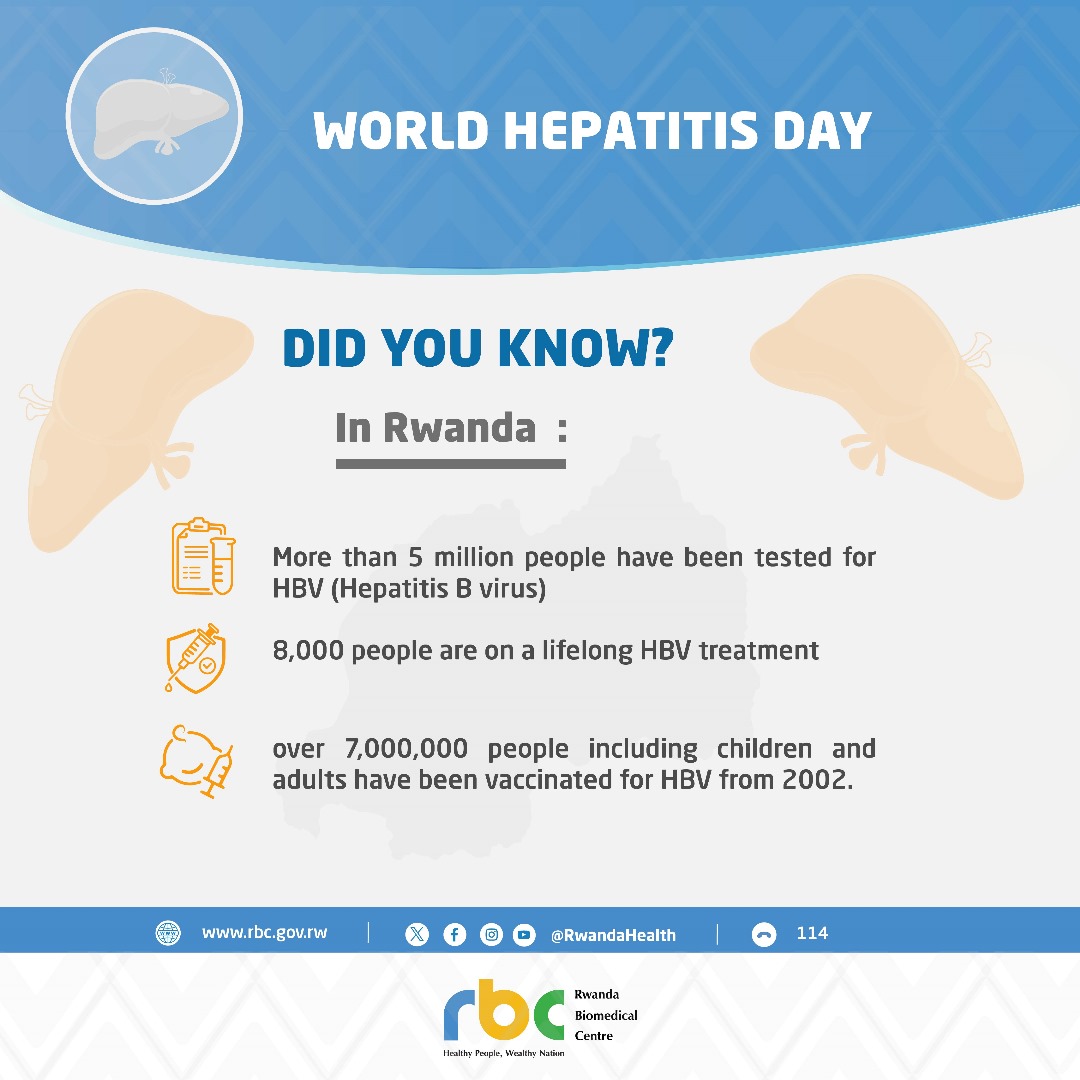
More than 5 million people have been tested for HBV and 8,000 people are on a lifelong HBV treatment and over 7,000,000 people including children and adults have been vaccinated for HBV from 2002.
The country’s achievements towards the elimination of viral hepatitis in Africa did not go unnoticed, recently, World Hepatitis Alliance recognized its outstanding contribution by presenting Rwanda with an award.
Rwanda looks to eliminate Hepatitis B by preventing transmission from mother to child, the introduced initiative that will be accomplished through screening and treatment of hepatitis B among all pregnant women and the use birth dose within
For the way forward, Rwanda determined to approach to eliminate Recent initiatives have also been introduced to eliminate Hepatitis B by preventing transmission from mother to child. This will be accomplished through routine screening and treatment of hepatitis B among all pregnant women as well as providing all infants with the first dose of the hepatitis B vaccine within 24 hours of birth.