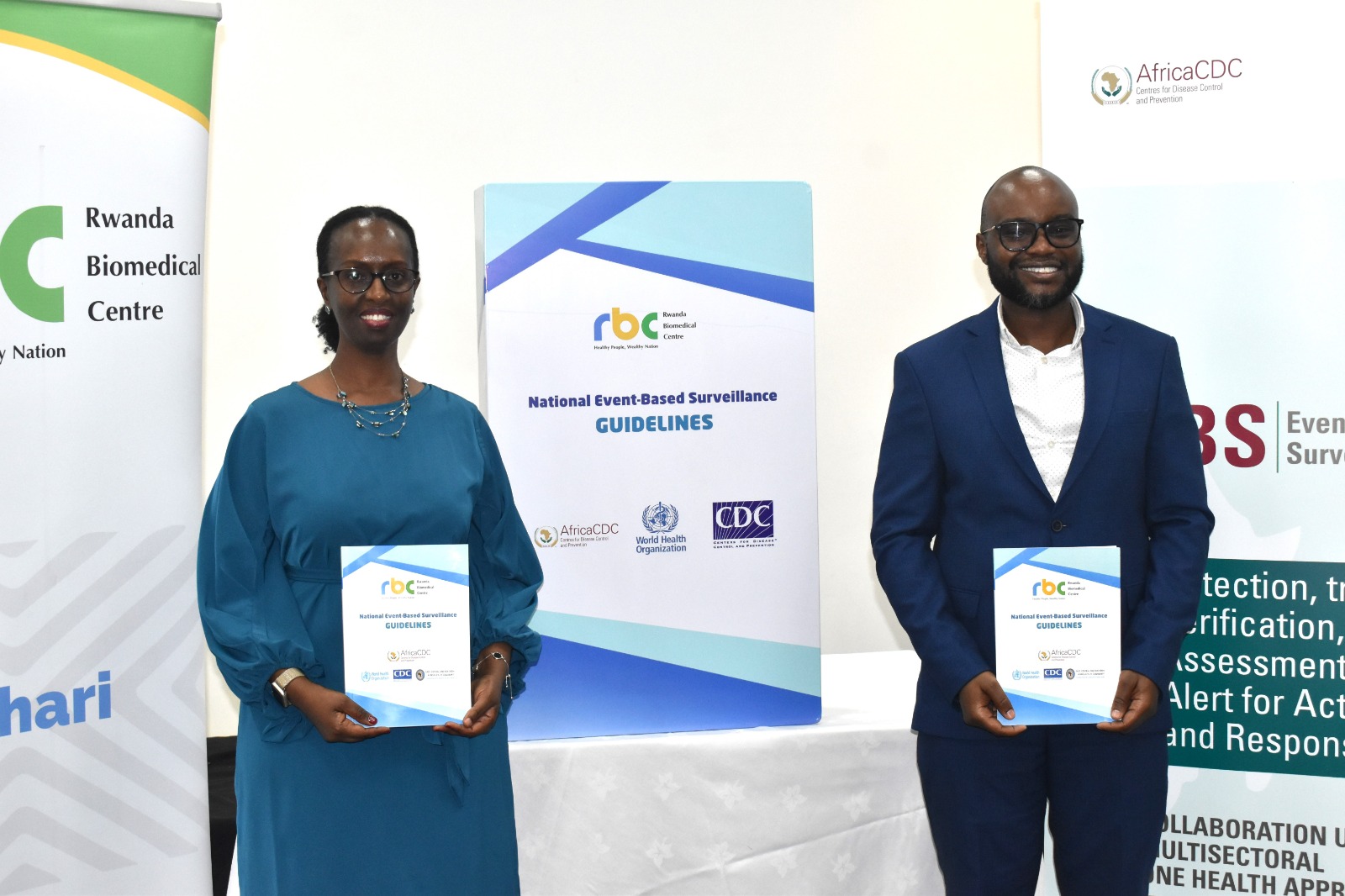
Rwanda Biomedical Centre through HIV/AIDs, Diseases Prevention and Control Department joined hands with Africa CDC together with other partners to put in place the Event-Based Surveillance guidelines to complement Indicators Based Surveillance (IBS) which has been in use since 2o12.

The Event-based surveillance (EBS) is defined as the organized collection, monitoring, assessment, and interpretation of mainly unstructured ad hoc information regarding health events or risks, that may represent an acute risk to health. The move will see Rwanda improve its Early Warning and Response system (EWAR) to meet the International Health Regulations (IHR) standards that require countries to develop capacities to enable them detect early, report, and respond to health threats in good time.
The upgraded surveillance that has been validated and launched earlier in September 2024, will be implemented under the One Health approach and is considered the key to rapid reporting and timely response to public health threats such as Mpox. EBS guidelines in Rwanda will serve with 4 main purposes including: to standardize surveillance practices nationwide, enhance early detection and reporting, strengthen response capacity and promote collaboration among stakeholders.
By following the key steps such as Detection, Triage, Verification, Risk assessment and Alert, the EBS guidelines will have following objectives:
- To rapidly detect signals that may indicate the occurrence of an unusual health incident, and respond to confirmed events.
- Improve the ability to detect unusual health events from various sources
- Enhance report of unusual health events or outbreaks to subsequent hierarchic levels
- Ensure prompt verification and comprehensive assessment of health risks associated with detected events
- Document the nature of the event through investigation, characterization, and etiological confirmation
- Enhance the timeliness required to initiate and implement response.
- Strengthen collaboration and information sharing among stakeholders involved in public health surveillance and response.
- Integrate analysis of data from multiple sources, to enhance the overall decision based on evidence.
- Enhance community participation in reporting and responding to public health events
In Rwanda, we have four types of EBS namely Community, Facility, Media Scanning and Hotline Event-Based Surveillance. Speaking at the event Dr. Lenny Kamau Gitundu, National Coordinator for Disease Control and Prevention at Africa CDC labeled the occasion as “a significant milestone in our collective effort to enhance public health systems across Africa.”
He added that the adaptation of the EBS in Rwanda aligns with Priority 2 of the Africa CDC Strategic Plan: Building proactive surveillance, intelligence gathering, and early warning systems. Effective surveillance and early warning systems are critical for detecting and monitoring disease outbreaks and ensuring timely responses to public health emergencies.
Rwanda’s surveillance systems have primarily used Indicator Based Surveillance (IBS), which relies on information collected in health facilities and targets known, reportable diseases or conditions. This type of surveillance does not always allow a rapid response, because of its limitation in early detection of public health events.
Adeline Kabeja, the Director of Surveillance Unit at Rwanda Biomedical Centre saluted the efforts all individuals and institutions involved in tailoring the EBS saying “the Event-Based Surveillance (EBS) Guideline we launched today is more than just a document. It serves as the foundation of our efforts to safeguard public health through a proactive and responsive framework.”
Kabeja added putting in place the guideline of such caliber highlights “our commitment to enhancing health security by providing a framework for timely detection, assessment, and response to public health events by ensuring we adhere to global best practices while addressing our local.”