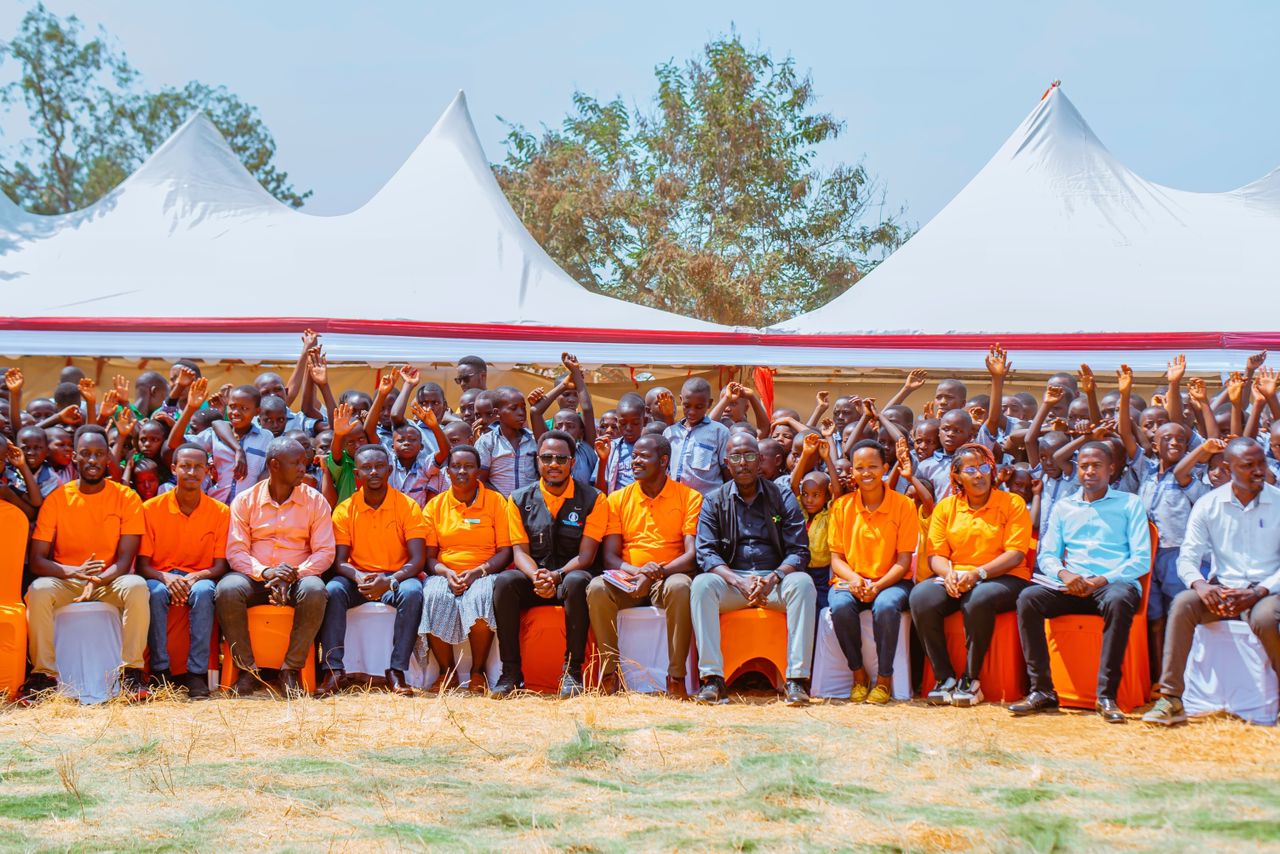
Rwanda Biomedical Centre (RBC) in partnership with Merck Group (German multinational science and technology company) completed the first phase of the Bilharzia storytelling lab project in Rweru Sector, Bugesera District on Friday, July 12.

Forty-one students received scholastic materials and had their school feeding fees covered for one year as recognition for their outstanding performance in Bilharzia storytelling.
The Bilharzia storytelling lab project, pioneering the use of communication as a strategy to combat Neglected Tropical Diseases (NTDs), commenced its pilot phase in 2023.
Bertrand Byishimo, founder of the project, explained, “The initiative involved distributing homework notebooks containing Bilharzia awareness messages and organizing storytelling contests in schools such as Groupe scholaire Nyiragiseke, École Primaire Mugina, and École Primaire Kivusha in Rweru Sector, Bugesera District. The goal was to actively engage students in disease prevention protocols.”
He emphasised that the project aims to place individuals, especially students, at the forefront of prevention efforts.
Byishimo noted that the objective of the project is to significantly contribute to the efforts of Bilharzia elimination in Bugesera District, through a comprehensive communication project, using the notebooks designed with Bilharzia precaution drawings, which were distributed in schools to increase awareness about the disease and its prevention.
The materials were developed in local languages to ensure they are accessible to the target audience.
The project aimed to enhance awareness and disseminate information regarding the disease, encompassing its causes, symptoms, prevention methods, and treatment. Its objective was to alleviate the disease burden within affected communities. Awareness was fostered through student-led research activities involving reading and gaining deeper insights into the disease, Byishimo stated.
Additionally, learners participated in writing, singing, and creative storytelling contests, thereby demonstrating their acquired knowledge of the disease.
Ladislas Nshimiyimana, an NTD Research Senior Officer at the Rwanda Biomedical Center (RBC) in the Department of Malaria and Other Parasitic Diseases Division under the NTD and Other Parasitic Diseases Unit said, “We had realised that it is not possible to fight Bilharzia in this sector, because it is one of the sectors that has the higher prevalence of Bilharzia. However, by ensuring more community engagement activities and health promotion, we believe that this disease can be eliminated.”
He added: “This Bilharzia storytelling lab looks promising, and it should be applied even in other sectors. We believe that a child is a perfect messenger, so please take this message to your parents.”
Ruth Kemirembe, a representative of Bugesera District, noted the substantial learning derived from the project, noting that as grassroots leaders, they have gained invaluable awareness. She highlighted the critical importance of information in disease prevention, expressing optimism that the knowledge acquired from this initiative will contribute significantly to disease elimination efforts.
Julien Mahoro Niyingabira, a Health Communications Division Manager at Rwanda Biomedical Centre and Ministry of Health noted that there was a change in the behavior of children.

“ I have observed that this project has positively influenced some of your behaviors. It is through information that you can protect yourselves from these diseases. From today onward, if a parent sends you to fetch water without shoes, kindly inform them that it is not advisable,” Niyingabira told learners.
“NTDs are hygiene-related illnesses that do not necessarily require highly trained doctors for treatment; rather, they can be addressed through basic knowledge of hygiene practices such as cleanliness and personal care.”
He encouraged learners to continue collaborating towards the goal of eliminating these diseases by 2030.
Dr Eric Niyongira, the coordinator for Interruption of Transmission for Bilharzia and Soil Transmitted Helminthes at Rwanda NGO’s Forum on AIDS and Health Promotion (RNGOF)
appreciated the way learners received the information, and stressed that it is clear that their knowledge on Bilharzia has increased.
He called upon learners to spread the information to their parents and community members among others.
Jean Marie Vianney Hategekimana, the Rweru Sector leader said: “We really appreciate your efforts to ensure the wellbeing of our livelihoods. Hence, we are also ensuring that we help alleviate the health conditions of the residents of this area.”
Bilharzia, also known as Schistosomiasis, is a parasitic disease caused by a type of worm that is found in contaminated water. The disease is prevalent in many developing countries and has a significant impact on public health. It is estimated that over 200 million people are infected with Bilharzia worldwide, and 90 percent of these cases occur in sub- Saharan Africa, according to the World Health Organization (WHO).
RBC statistics show that in Rwanda, currently 1013 cells are at risk of Bilharzia and receive mass treatment once a year. More than 1,200 cases of Bilharzia are reported in health facilities annually and children are the most affected.
According to the Rwanda 2020 mapping survey, Bugesera District exhibits a high prevalence of Bilharzia, posing a significant public health challenge. The proximity of many residents to Lake Cyohoha increases their susceptibility to this parasitic disease.